Why an impact pathway, and why ex ante
Too often impact is written at the end, to justify a project. Structured from the start, it sharpens the research question, brings in expertise that is not necessarily academic, and surfaces the stakeholders and real-world uses that make a proposal convincing.
A business plan
- Financial projections
- Required resources
- Operational capacity
A single-instrument score: one melody.
An impact pathway
- Economic reality
- Societal resonance: acceptability, validated needs
- Environmental impact: resource sustainability, operational risk
A full orchestral score: every interaction.
What is inside
- 1
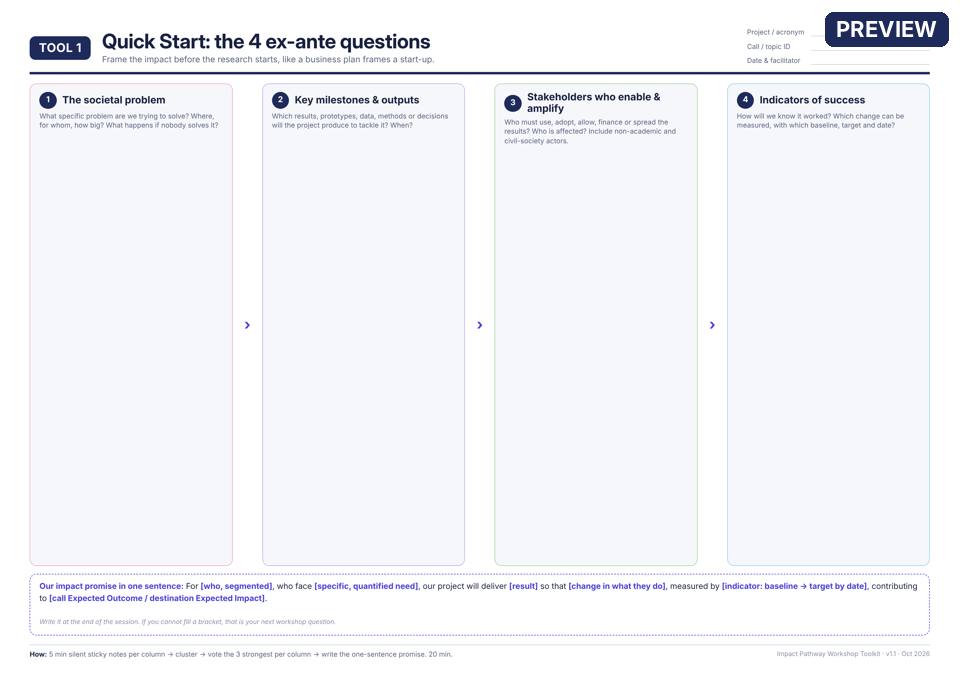
Quick start: the four ex-ante questions
The societal problem, the milestones and outputs that tackle it, the stakeholders who enable and amplify the impact, and the indicators of success — closed by a one-sentence impact promise.
- 2
Call deconstruction & alignment matrix
Split the topic's Expected Outcomes and the destination's Expected Impacts into numbered statements, check whether all or only some must be addressed, and map your project onto each row.
- 3
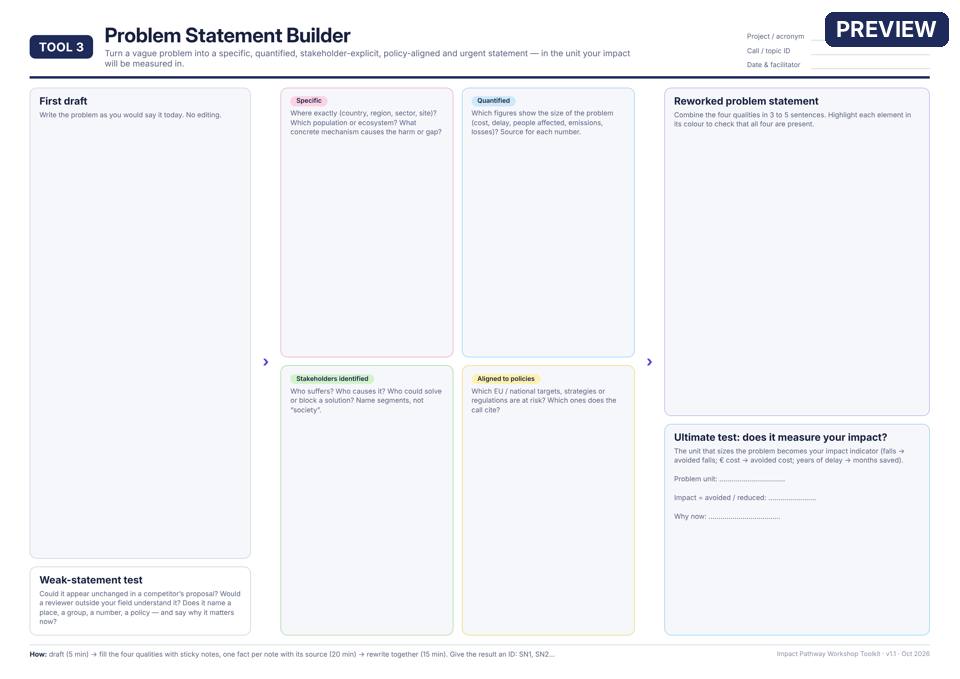
Problem statement builder
Turn a vague problem into one that is specific, quantified, names its stakeholders, is aligned with policy and says why now — in the unit your impact will be measured in.
- 4
Stakeholder & target-group map
Users, beneficiaries, enablers, decision-makers and affected groups across six sectors, narrowed to precisely named priority segments.
- 5
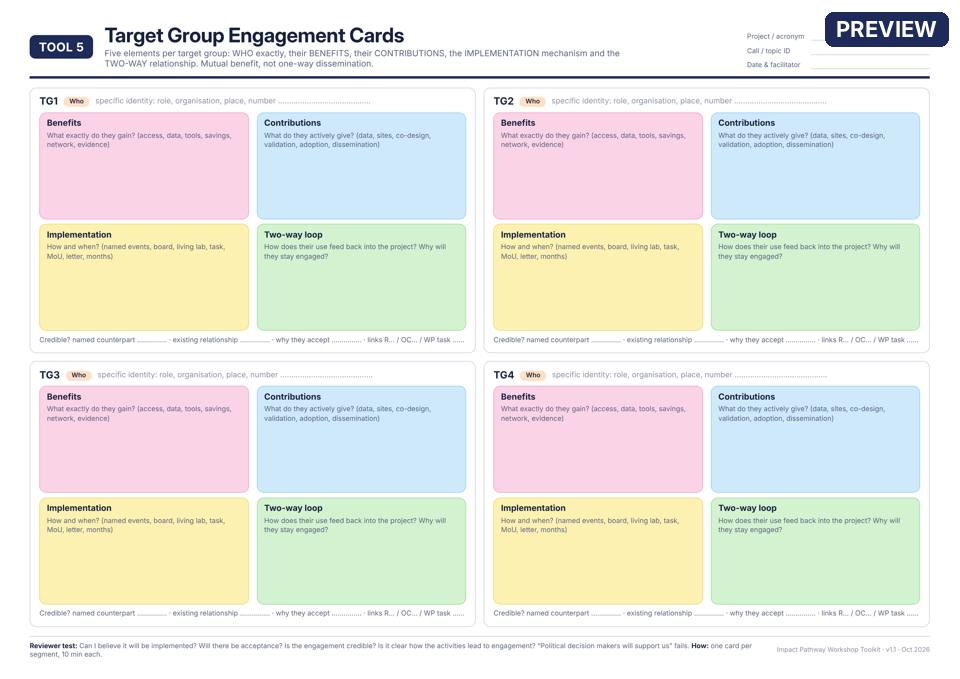
Target-group engagement cards
Five elements per segment: who exactly, their benefits, their contributions, the implementation mechanism and the two-way relationship — with a credibility line evaluators can believe.
- 6
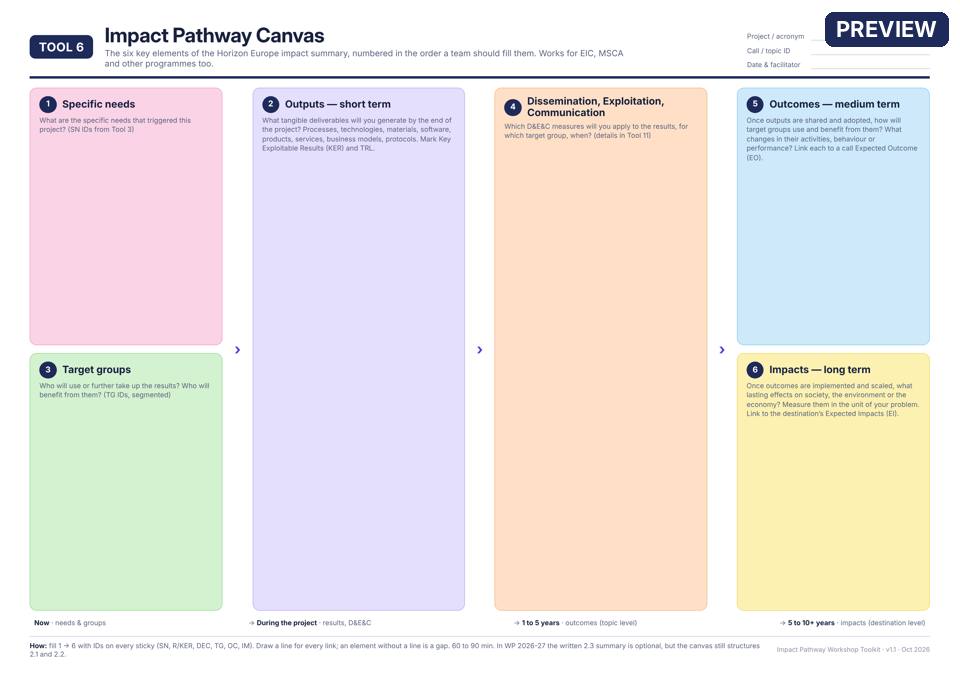
Impact Pathway canvas
The six key elements in the order a team should fill them, with the three layers made explicit: outputs (short term), outcomes (medium term) and impacts (long term).
- 7
Outcome & impact chains
One lane per priority outcome: result, uptake mechanism, target group, outcome, impact and indicator, with the sentence patterns that go into the proposal.
- 8
Impact typology grid
Scientific, communication, economic, societal, environmental and systemic impacts, so nothing the call implies is forgotten.
- 9
KPI definition sheet
Indicator, level, unit, baseline with source, target, timeframe, method, data owner and the outcome or impact it evidences.
- 10
Barriers, assumptions & side effects
External barriers beyond the project, how they may change, mitigation, rebound and life-cycle effects, who could lose, and stop-or-pivot criteria.
- 11
Dissemination, exploitation & communication plan
Measures per target group and an exploitation route per key result, with IP protection and the next financing step.
- 12
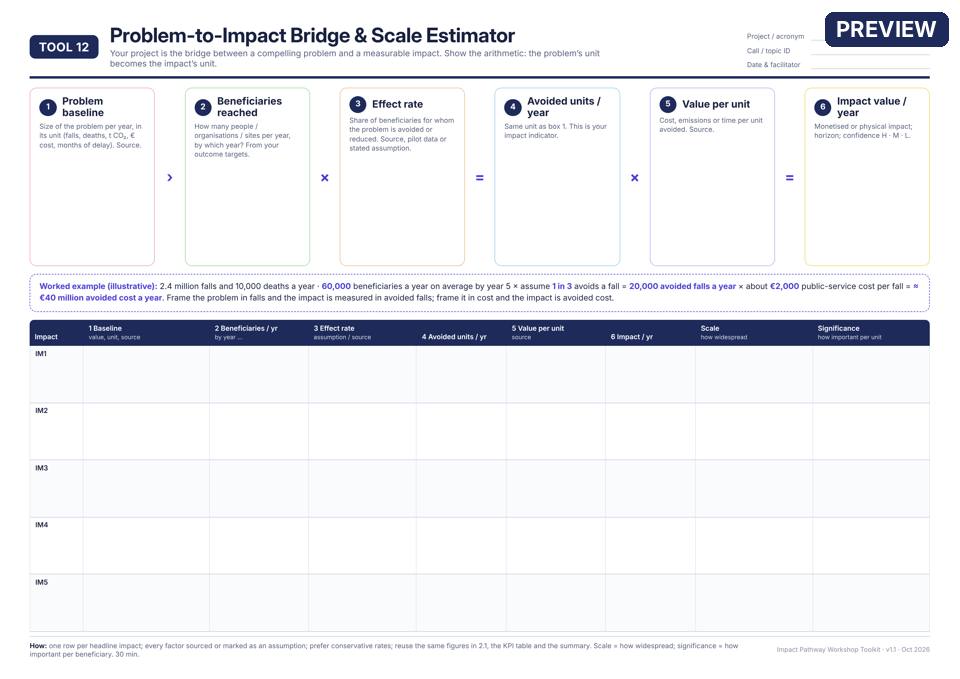
Problem-to-impact bridge
Your project is the bridge: problem baseline, beneficiaries reached, effect rate, avoided units and value — the arithmetic behind every headline impact.
- 13
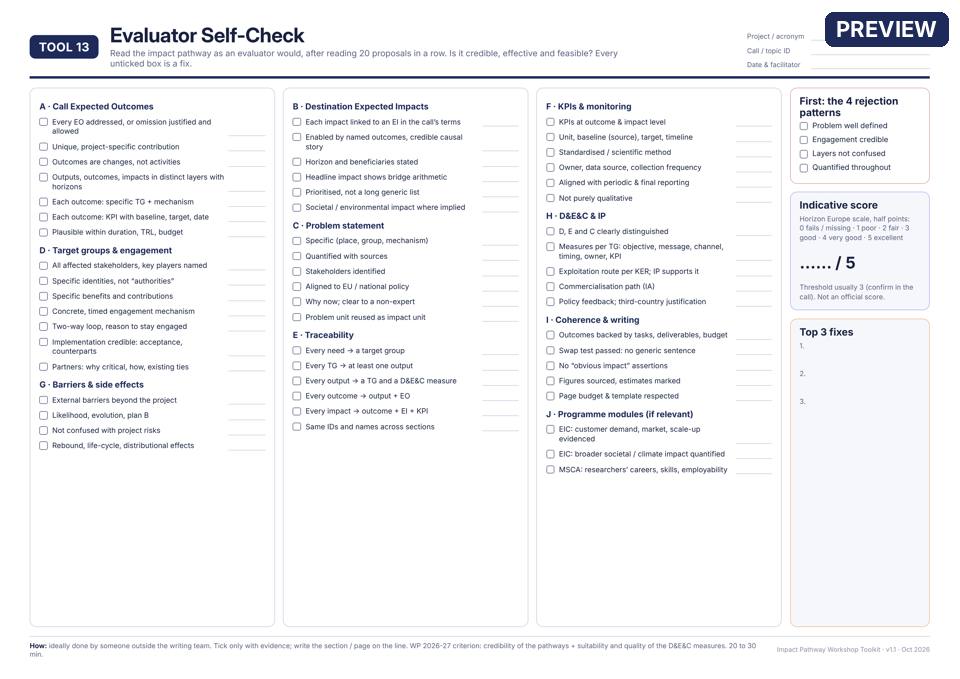
Evaluator self-check
The four rejection patterns first, then the checklist an evaluator effectively runs on an impact section, with space for evidence and the top three fixes.
- 14
Impact monitoring & reporting tracker
Track the promised indicators from day one — owner, source, frequency, values per reporting period — so periodic and final reports are ready and the pathway can adapt.
A look at the canvases
Low-resolution previews. The full set prints at A1 or A0 and imports as locked backgrounds into Miro, Mural or FigJam.
How it fits the evaluation
For Work Programme 2026–2027 calls, the Horizon Europe Impact criterion asks for credible pathways to the expected outcomes and impacts in the work programme, and for suitable measures to maximise them. The canvases follow that logic: outputs, outcomes and impacts are kept in separate layers, outcomes are read from the topic and impacts from the destination, the problem’s unit becomes the impact’s unit, and every element is traced from need to indicator. The guide also explains how to adapt the same chain for the EIC, Eurostars and MSCA. Where the toolkit and your live call disagree, your call wins.
GrantWise is independent and is not affiliated with, endorsed by, or acting on behalf of the European Commission, the European Innovation Council, Eureka or any other funding authority.
The toolkit helps you build the pathway. A review tells you whether it holds.
Upload your application for an independent, criteria-aligned review: every finding names where it sits in your text, which criterion it affects and how to fix it.